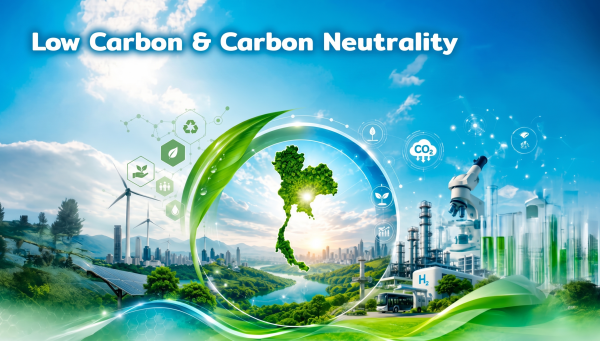
Over the past decade, low carbon development and carbon neutrality have evolved from environmental goals into important economic drivers shaping trade, investment, and national competitiveness. As Thailand moves toward a low-carbon economy, NSTDA is accelerating the development of knowledge, technology, and innovation to support this transition—from fundamental research and deep technology to practical applications in industry and society.
In response to increasingly stringent global carbon regulations, NECTEC developed the Carbon Accounting Management Platform (ACAMP), a digital solution that simplifies carbon accounting for businesses. By integrating IoT devices with cloud-based systems, ACAMP automates greenhouse gas data collection, enables real-time emissions analysis, and supports compliance with international standards. The platform helps businesses improve efficiency, reduce errors, and lower long-term costs while advancing sustainability goals.
NSTDA is also addressing food waste, which remains both an environmental and social challenge in Thailand. Each year, the country generates nearly 10 million tons of food waste, including around 4 million tons of edible food, while many vulnerable groups continue to face food insecurity. Through BIOTEC, NECTEC, and MTEC, NSTDA has partnered with the SOS Foundation and networks across the public, private, and civil sectors to support the Thailand Food Bank, a non-profit initiative that redistributes surplus food to people in need. NSTDA’s contributions include food donation safety guidelines developed by BIOTEC, an AI-based matching platform by NECTEC to connect donors and recipients and optimize logistics, and a carbon database by MTEC to calculate carbon credits based on national standards.
To strengthen waste management through digital innovation, MTEC, with support from government research funding and UNEP, developed the Lookie Waste platform to track food and packaging waste from source to disposal. Designed for businesses, restaurants, retailers, households, and waste managers, the platform uses image processing technology to identify waste type and volume. It also evaluates environmental impacts in carbon dioxide equivalents (CO2-eq), estimates the economic cost of wasted food, and highlights social impacts by translating waste into nutritional value and the number of children who could have been fed with the discarded food.
These innovations reflect NSTDA’s commitment to building the infrastructure needed for a low-carbon economy. As carbon reduction becomes an increasingly important measure of future competitiveness, NSTDA is helping lay the foundation for sustainable growth in Thailand through science, technology, and innovation.