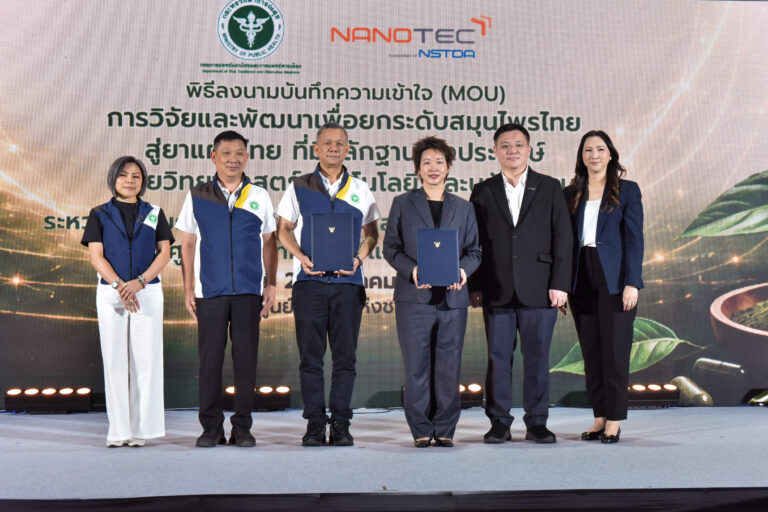
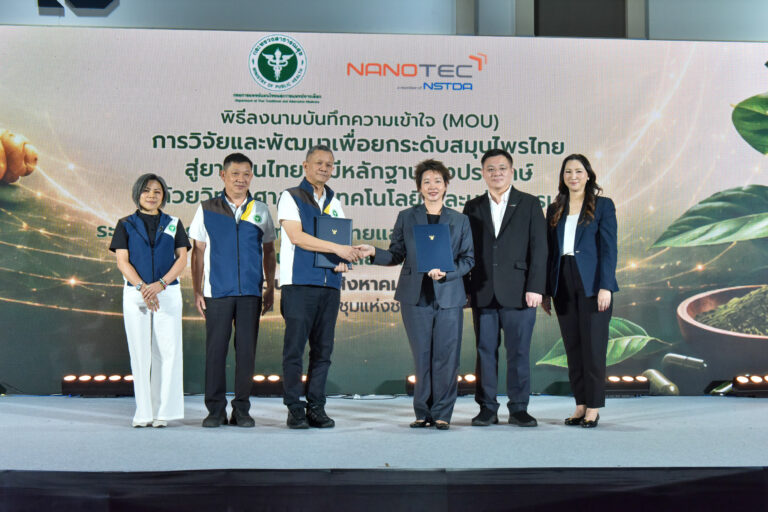
The National Science and Technology Development Agency (NSTDA), through the National Nanotechnology Center (NANOTEC), and the Department of Thai Traditional and Alternative Medicine (DTAM) have signed a Memorandum of Understanding (MOU) to advance Thai herbal medicines and traditional formulations through science, technology and innovation.
The collaboration is aimed at raising Thai herbal products to higher standards of quality, safety and efficacy, while strengthening the scientific evidence needed to support broader healthcare applications, public confidence and international market opportunities. By integrating nanotechnology with traditional Thai medical knowledge, the partnership will help unlock new value from Thailand’s herbal resources and support the country’s growing health economy.
Under the collaboration, nanotechnology will be applied to improve the stability, solubility, absorption and delivery of bioactive compounds derived from Thai herbs. These advances are expected to address long-standing limitations of herbal extracts and formulations, while supporting the development of safer, more effective and more practical products for use in modern healthcare.
The partnership also provides a framework for combining NSTDA’s research and innovation capabilities with DTAM’s expertise in Thai traditional and alternative medicine to identify high-potential herbs and traditional formulations for further development. The work will focus on generating scientific evidence on active compounds, biological activities, safety and efficacy, helping translate traditional knowledge into evidence-based products with stronger innovation and commercial potential.
Initial areas of collaboration will focus on three promising applications: sleep support, allergy symptom relief and pain relief. In these areas, both organizations will jointly evaluate selected herbs and formulations and further develop them through modern scientific and technological approaches.
The collaboration marks an important step in linking Thai traditional wisdom with advanced science and innovation. It is expected to strengthen Thailand’s research and healthcare capabilities, expand opportunities for value-added herbal products and contribute to the positioning of Thai traditional medicine as a strategic component of the national health economy and soft power development.