Rice cultivation that keeps fields continuously flooded is a major source of methane emissions, one of the most potent greenhouse gases contributing to global warming. Because methane has a significantly stronger warming effect than carbon dioxide, improving water management in rice farming has become an important pathway for reducing agricultural emissions.
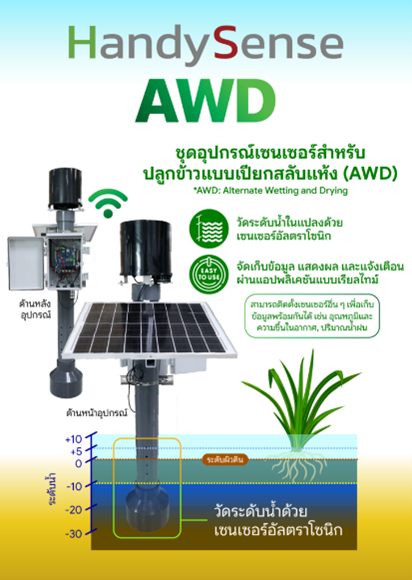
To address this challenge, NSTDA by NECTEC has developed HandySense AWD, an innovative water-level sensing solution designed to support alternate wetting and drying (AWD) in rice cultivation and advance low-carbon rice farming in Thailand.
By enabling more precise water management, HandySense AWD helps reduce methane emissions by 30–50% and lower water use by 15–30% throughout the cultivation cycle. Equipped with ultrasonic sensors, the system measures water levels in rice fields and transmits real-time data to a cloud-based dashboard accessible via smartphone or computer, allowing farmers to make timely and informed irrigation decisions. The platform also supports additional environmental sensors, such as temperature, humidity, and rainfall sensors, and is designed for field deployment with solar power and battery support.
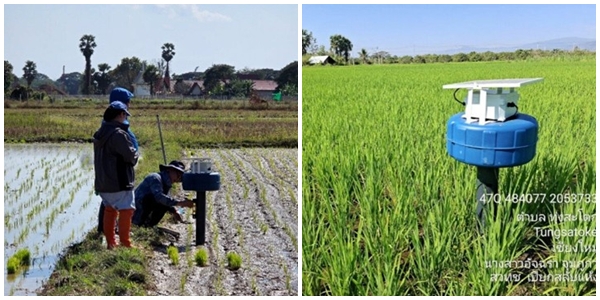
Beyond on farm use, the technology is being applied to support low carbon rice research in collaboration with BIOTEC. Field installations have been carried out in Phichit, Lampang, and Chiang Mai, covering more than 20 research sites, to collect data on water levels and methane emissions under different cultivation conditions. The resulting data will contribute to the development of suitable approaches for promoting low carbon, high productivity rice farming for Thai farmers.
HandySense AWD is also available under an open innovation model, allowing agricultural technology developers and farmers to access the technology free of charge and use its blueprint for further development and wider application. In parallel, work is underway on a carbon-footprint application that will integrate field data from HandySense AWD with farm activity records to support greenhouse gas assessment and future carbon credit opportunities. By combining digital sensing, real-time field monitoring, and practical application in rice cultivation, HandySense AWD demonstrates how innovation can help farmers respond to climate and resource challenges more effectively. The technology not only supports better water management and lower greenhouse gas emissions, but also creates opportunities for wider adoption of low-carbon rice farming, stronger environmental reporting, and future carbon credit mechanisms. This reflects NSTDA’s role in turning research and technology into practical solutions that strengthen the sustainability and resilience of Thai agriculture.