
Public safety and environmental sustainability are taking center stage in Thailand’s energy sector with the introduction of EnPAT, an innovative bio-based transformer oil developed from domestic palm oil.
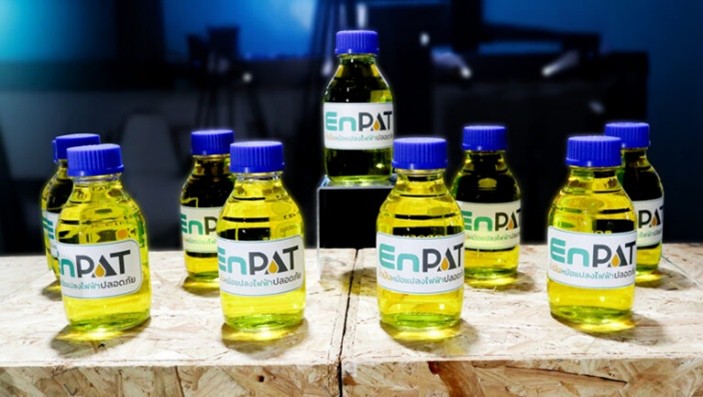
This breakthrough is the result of over seven years of intensive research led by the National Energy Technology Center (ENTEC) under the National Science and Technology Development Agency (NSTDA), in collaboration with a robust network of partners including the Department of Alternative Energy Development and Efficiency (DEDE), the Provincial Electricity Authority (PEA), and private sector leaders like Global Green Chemicals Public Company Limited (GGC) and Enserv Power Company Limited.
Traditional transformers typically rely on mineral oil for insulation and cooling. However, mineral oil has a low fire point (approx. 140-150°C), posing a significant risk of fire outbreaks if a transformer explodes. EnPAT addresses this vulnerability with a fire point exceeding 300 degrees Celsius—more than twice as high as conventional mineral oil. Classified as a "Less Flammable Fluid" (Class K), this superior thermal stability drastically reduces the risk of fire spreading to nearby residential areas, ensuring greater safety for lives and property.
Beyond safety, EnPAT is a cornerstone for Thailand’s "Green Electricity" goals. Composed of 97% natural palm oil, the product is non-toxic and over 95% biodegradable within 28 days, whereas mineral oil takes decades to decompose.
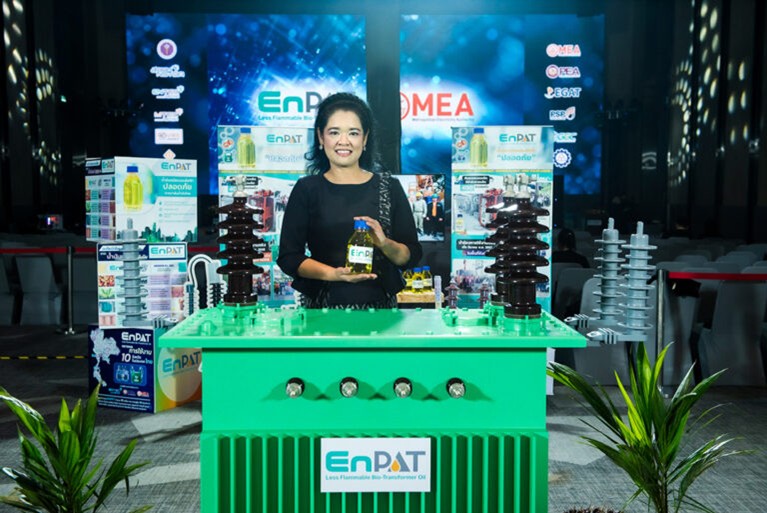
(Dr. Boonyawan Yoosuk, Head of Clean Fuel Technology and Advanced Chemistry Research Team, ENTEC)
The environmental benefits are immense: if adopted nationwide to replace the estimated 33 million liters of mineral oil used annually, EnPAT could reduce carbon emissions by as much as 38 million kgCO2 eq per year—equivalent to planting 4 million trees. This directly supports Thailand’s commitment to achieving Net Zero emissions by 2050 and aligns with the Bio-Circular-Green (BCG) economic model.
EnPAT also strengthens Thailand’s economy by utilizing abundant domestic palm oil resources, reducing the need for expensive imported mineral oils. The project promotes a circular economy: once the oil reaches the end of its operational life (approximately 20–25 years), it can be recycled into biodiesel (B100), ensuring a zero-waste lifecycle.
The innovation has already moved beyond the lab. It has been successfully tested in pilot projects with the Provincial Electricity Authority (PEA), including installations at the Princess Sirindhorn International Environmental Park and the 60th Anniversary of His Majesty King Bhumibol Adulyadej the Great Park.
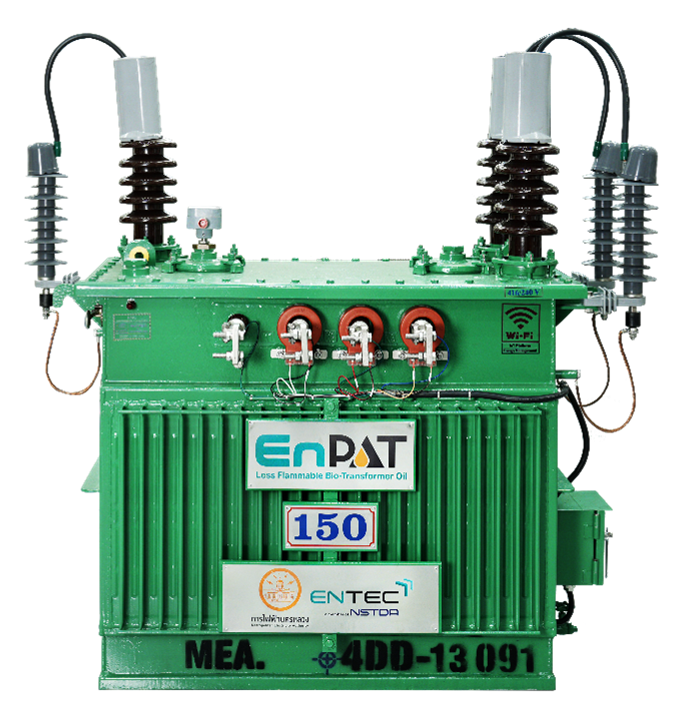
The excellence of EnPAT has been recognized globally and locally, winning several prestigious awards, including:
- The Prime Minister’s Award at Thailand Energy Awards 2024.
- The Winner of the ASEAN Energy Awards 2024 in the Renewable Energy (Special Submission) category.
EnPAT stands as a powerful example of how "Home-grown Science" and strong public-private partnerships can deliver high-impact solutions for a sustainable, resilient, and safer future for all Thais.