
The NSTDA, through its National Center for Genetic Engineering and Biotechnology (BIOTEC), has developed a biological innovation for fruit fly control to help reduce chemical use in orchards and support safer, higher-value fruit production in Thailand. The technology was presented in Ratchaburi as a practical alternative for growers seeking more sustainable pest management solutions.
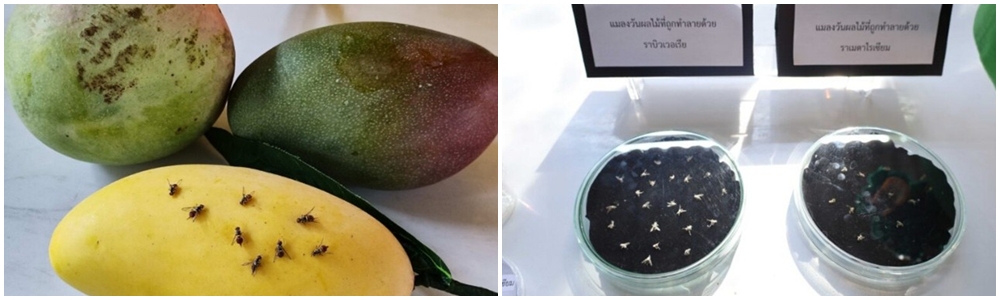
Fruit flies, particularly Bactrocera dorsalis, are a major pest affecting Thailand’s economic fruit crops, including mango, guava, and rose apple. In addition to causing losses in yield and quality, the pest is also subject to phytosanitary restrictions in many countries, making it an important challenge for Thai fruit exports. At the same time, continued reliance on chemical pesticides can lead to residue concerns, health risks, environmental impacts, and insect resistance.
To address this challenge, BIOTEC researchers developed a biological product and bio-trap system for fruit fly control using the entomopathogenic fungi Beauveria bassiana strain BCC 2660 and Metarhizium anisopliae strain BCC 4849. A key strength of the innovation is its attract and release mechanism, in which infected fruit flies return to spread the fungi within the natural population, enabling continuous control of both flies that enter the trap and those that do not. The system is also designed to be simple to produce, easy to use, rapid to deploy, and low in cost, making it suitable for commercial agricultural application.
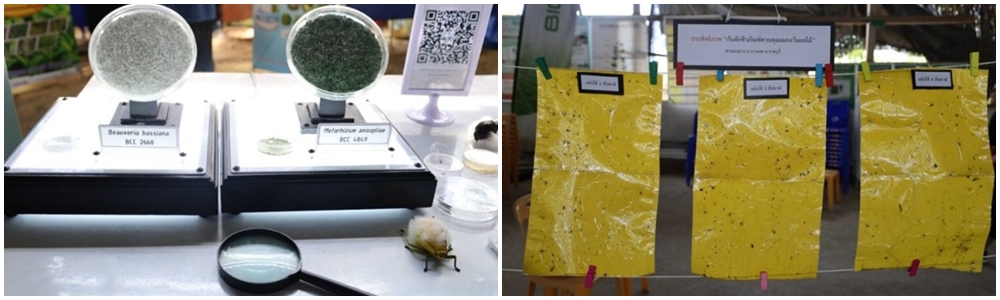
Field validation at a mango orchard in Suan-Suk-Jarun, demonstration site located in Ratchaburee Province, showed that the biological trap could control both male and female fruit flies, unlike conventional pheromone traps such as methyl eugenol, which target only males. When used twice per month at a rate of four traps per rai (roughly 0.4 acres) in place of chemical spraying, the system achieved 85–91% control efficiency, while also reducing labor costs, lowering the need for fruit bagging, and cutting chemical costs by more than 1,000 baht per rai per month.
This innovation reflects NSTDA’s role in advancing research-based solutions for Thai agriculture by translating biotechnology research into practical tools that farmers can adopt in real production settings. By helping reduce dependence on chemical pesticides while improving produce safety and market competitiveness, the technology contributes to more sustainable and environmentally friendly fruit production in Thailand.
The initiative is expected to contribute to improved produce quality, higher incomes for Thai farmers, and the advancement of sustainable agriculture in Thailand. In this regard, BIOTEC, NSTDA welcomes collaboration with private sector partners, entrepreneurs, and farmers to further develop this innovation for commercial utilization and wider application across the agricultural sector.