
As demand for clean energy grows, land use is becoming an increasingly important issue, especially in agricultural economies such as Thailand where large areas are needed for food production. Agrivoltaics, also known as solar sharing, offers a practical approach by allowing crops and solar power generation to coexist on the same land.
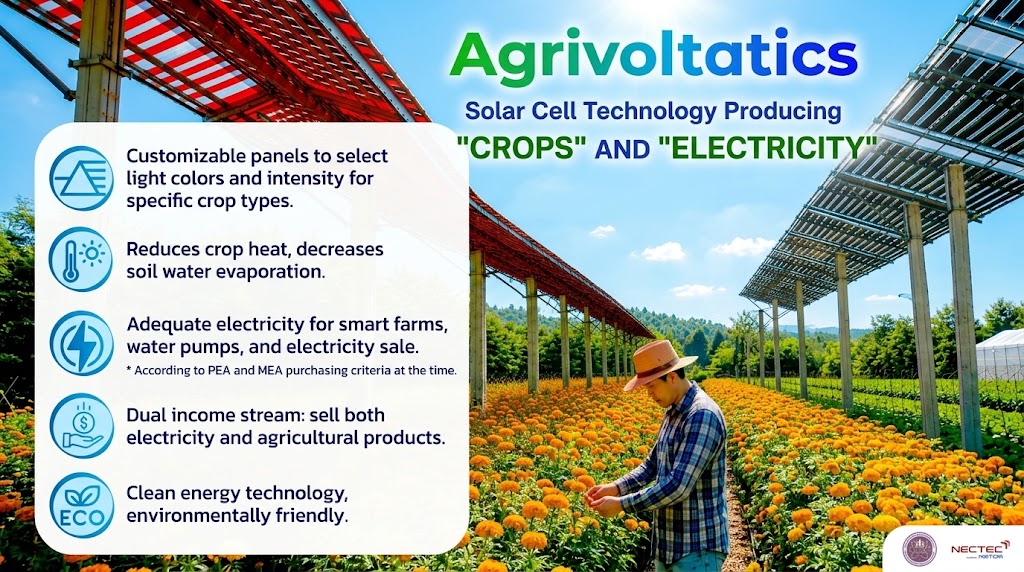
The National Science and Technology Development Agency (NSTDA), under the Ministry of Higher Education, Science, Research and Innovation, has developed agrivoltaics technology based on selectively transmissive solar panels that support both agricultural production and electricity generation. The work was carried out through collaboration among the National Electronics and Computer Technology Center (NECTEC), the National Energy Technology Center (ENTEC), and the National Center for Genetic Engineering and Biotechnology (BIOTEC).
Unlike conventional solar panels, these panels are designed to allow selected wavelengths and levels of light to pass through to the cultivation area below. This helps create more suitable growing conditions for crops, while also reducing heat buildup beneath the panels and lowering water evaporation from the soil. The result is a system that aims to improve land-use efficiency while maintaining the benefits of solar energy production.
The technology builds on NSTDA’s earlier work in building-integrated photovoltaics, or BIPV, and has been adapted for agricultural use. Development of the original BIPV panels received research and development support from PTT Public Company Limited, and the technology was later extended into agrivoltaics in collaboration with Solartron Public Company Limited, which has received the manufacturing technology transfer.
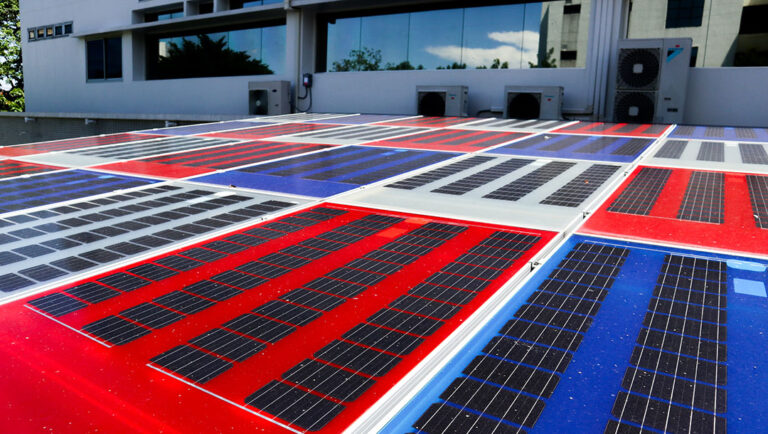
Crop-specific light management is a central feature of the system. Different plants respond to different light spectra and intensities, making panel selection an important consideration. White or transparent panels are better suited to crops that require high light intensity, red panels can help promote flowering, and blue panels are more suitable for crops that perform better under lower light intensity.
Initial trials have shown encouraging results. Red roselle grown under red panels produced more flowers and leaves, with larger leaf size than roselle cultivated under conventional opaque solar panels. Trials involving Wolffia under red and blue panels also found higher fresh weight and increased protein content in some seasons compared with conventional cultivation.
Installation design is another important part of the research. NSTDA’s agrivoltaics panels are designed to be installed at a height of around two to three meters above the ground, significantly higher than standard solar panels. This creates sufficient space below for cultivation, livestock raising, and the movement of agricultural machinery. Panel orientation and seasonal shading patterns are also being studied to ensure that installation designs match local growing conditions and crop requirements.
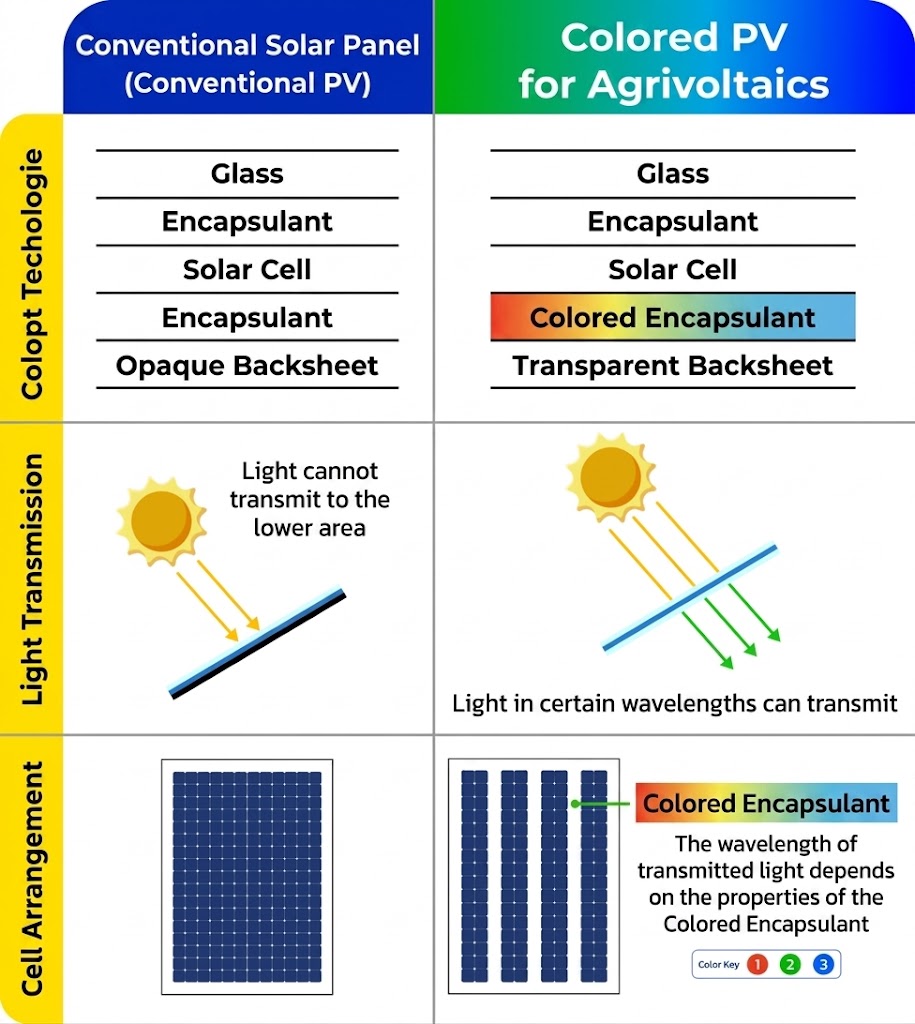
Although electricity generation decreases as panel transparency increases, the system is expected to produce enough power to support smart farming applications such as automated systems, greenhouse operations, and water pumping. In cases where electricity production exceeds on-site demand, surplus power may be sold to the Metropolitan Electricity Authority or the Provincial Electricity Authority, subject to the applicable purchasing conditions.
Agrivoltaics is gaining attention as a practical way to expand renewable energy generation without displacing agricultural land. NSTDA’s work highlights how solar technology can be adapted to support both energy and food production, while also improving resource efficiency and creating additional economic value. The agency is continuing to work with interested businesses to explore suitable deployment models for different agricultural contexts.