
The global shrimp aquaculture industry faces a silent but devastating enemy: Enterocytozoon hepatopenaei (EHP). This microsporidian parasite, which causes Hepatopancreatic Microsporidiosis, is notorious for causing stunted growth and chronic mortality in Black Tiger and Pacific White shrimp. In Thailand alone, EHP is estimated to drain between $180 million and $240 million USD (6–8 billion THB) from the economy annually.
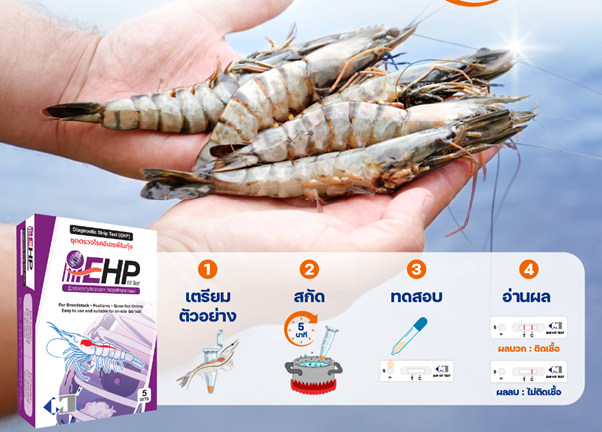
To address this, Thailand’s National Center for Genetic Engineering and Biotechnology (BIOTEC), National Science and Technology Development Agency (NSTDA) have launched a revolutionary on-site diagnostic kit that delivers results in just 25 minutes.
Traditionally, detecting EHP required sophisticated laboratory equipment, such as high-powered microscopes or PCR (Polymerase Chain Reaction) machines. For farmers, this meant a logistical hurdle: Shipping samples to labs, high costs, and a 2-3 day waiting period, an on-site, 4-step process (Prepare, Extract, Test, Read) that requires no specialized laboratory environment.
The kit recently achieved international acclaim, winning the Grand Prize and a Gold Medal at the 2026 Bangkok International Intellectual Property, Invention, Innovation and Technology Exposition (IPITEx).
Despite its simplicity—resembling a lateral flow assay where results are read via red bands (T and C lines)—the technology does not sacrifice precision. Validation studies show a 100% accuracy correlation with qPCR (quantitative PCR) when testing symptomatic shrimp. This allows farm managers to make critical decisions in real-time rather than waiting days while an infection spreads.
Recognizing that EHP is a global crisis affecting North and South America as well as Asia, the technology has been licensed to Marine Leader Co., Ltd., a major aquaculture supplier. The company is currently spearheading an international rollout to help farmers implement "proactive biosecurity."
The New Test Kit detection allows for immediate mitigation strategies, including:
- Isolation: Quickly quarantining infected ponds to prevent farm-wide contamination.
- Environmental Control: Adjusting feed and water quality to reduce shrimp stress and slow the parasite's impact.
- Resource Optimization: Enabling farmers to plan "emergency harvests" to recover costs before the disease leads to total crop failure.
As EHP remains a persistent threat to global food security and the blue economy, this rapid diagnostic tool represents a significant step toward sustainable aquaculture.