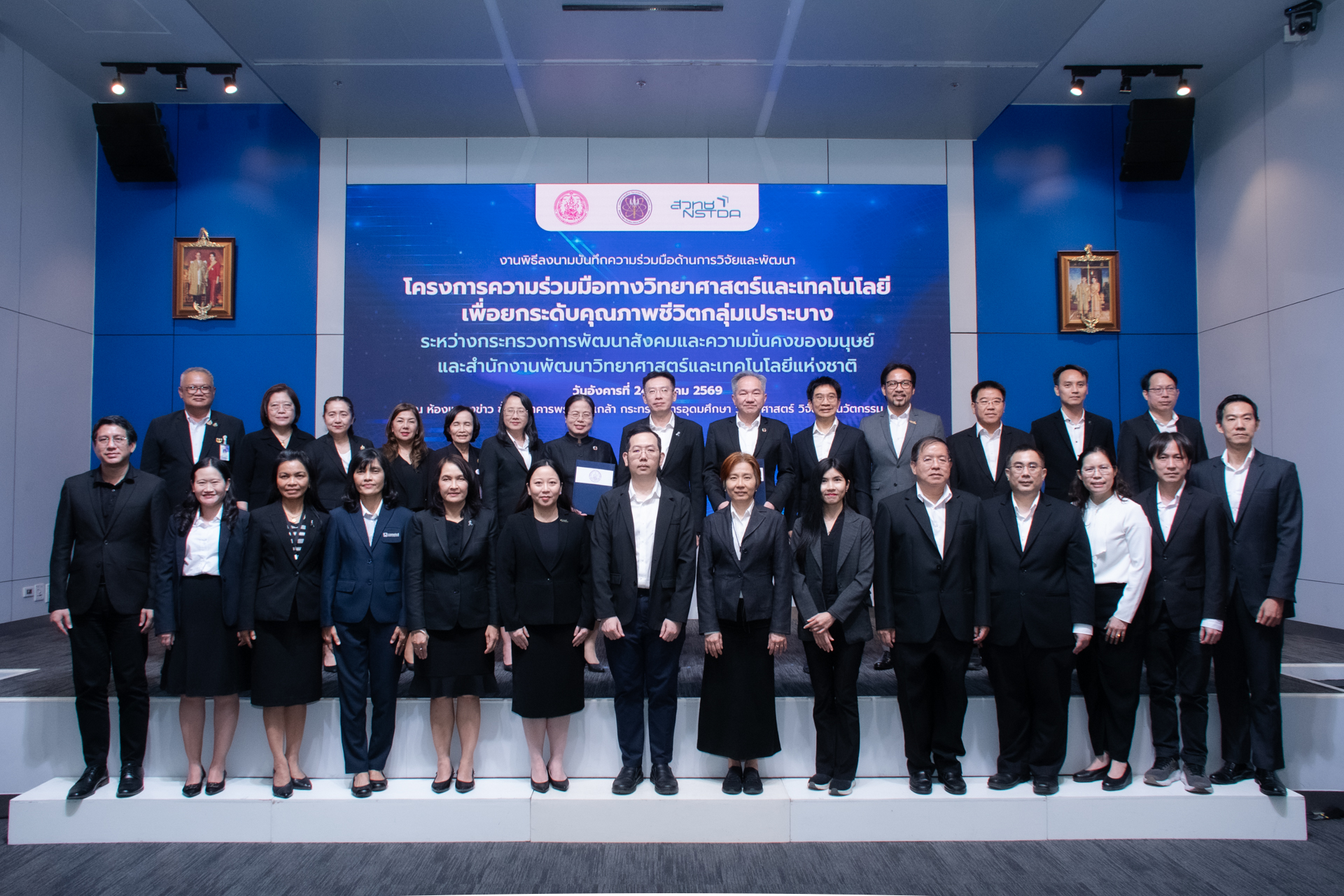
(March 24, 2026) – At the press conference room, 1st Floor, King Mongkut Building: The Ministry of Higher Education, Science, Research and Innovation (MHESI), in collaboration with the Ministry of Social Development and Human Security (MSDHS), officially signed a Memorandum of Understanding (MOU) on the “Science and Technology Collaboration Project to Enhance the Quality of Life of Vulnerable Groups.” Under this initiative, the National Science and Technology Development Agency (NSTDA) introduced a range of innovations, including AI-powered sign language interpretation, the Nirun elderly care system, and a digital family logbook. These technologies aim to provide integrated solutions to social challenges and improve the quality of life of vulnerable populations in a sustainable manner.

Professor Dr. Supachai Pathumnakul, Permanent Secretary of MHESI, stated that this collaboration represents the development of an innovation ecosystem aligned with the national strategy on “lifelong human development.” He emphasized that MHESI’s role is to translate research into real-world applications. Partnering with MSDHS is a significant step forward, as MSDHS has deep expertise in social dimensions, while NSTDA will leverage innovation as a tool to reduce inequality and ensure equitable access to opportunities for people of all ages, particularly vulnerable groups.

Ms. Tuenjai Kongsombat, Deputy Permanent Secretary of MSDHS, highlighted that the ministry is committed to ensuring equitable access to social welfare and services. The integration of NSTDA’s technologies will enhance the efficiency and precision of welfare delivery. She noted that the significance of this agreement lies not only in formal cooperation but also in the integration of data and tools, enabling MSDHS to better identify and reach vulnerable populations more quickly. This will modernize social services and improve long-term social stability and quality of life.

Professor Dr. Chookiat Limapijarn, President of NSTDA, stated that NSTDA is ready to support this initiative through research and resources across four key dimensions: economic development, self-reliance, inequality reduction, and environmental sustainability. NSTDA’s strong research teams have prepared ready-to-use innovations that will be integrated with MSDHS databases. This collaboration will focus on connecting key systems, particularly linking the MSDHS electronic family logbook (MSO-Logbook) with NSTDA’s Nirun system and KidDiary platform, ensuring seamless data integration and continuous welfare tracking for vulnerable populations. This marks a transition from research outputs to practical tools that can tangibly improve quality of life nationwide.

“This collaboration will enable the integration of resources across agencies to maximize efficiency, with clear goals and coordinated implementation, ultimately improving the quality of life for vulnerable groups and people of all ages in a tangible way,” said the NSTDA President.

Dr. Wason Phattarathikom, Assistant President of NSTDA, added that this partnership builds upon NSTDA’s ongoing collaboration with MSDHS departments since 2019. In addition to data integration for vulnerable group support, several innovations have been developed to enhance quality of life, including:
- SignTh AI: AI-powered sign language translation for the hearing impaired
- Elderly care innovations: health monitoring kiosks, rehabilitation devices, and “Kathy” hair-washing wheelchair for bedridden patients
- Nirun + ElderMeal: intelligent elderly care and nutrition system
- Assistive Technology: devices for persons with disabilities
- ThaiSook: digital health platform for aging society
- Food Bank: surplus food management system supporting vulnerable communities


Source: https://www.nstda.or.th/home/news_post/nstda-ai-support-vulnerable-groups-thailand-20260324/