

มาตรการส่งเสริม

Tools to support Science, Technology, and Innovation (STI)

NSTDA has applied knowledge in Science, Technology, and Innovation (STI) to develop tools that enhance the efficiency and safety of the project’s operations.

The key STI support tools for Thailand’s Food Bank include:

Food Donation Safety Guidelines

These guidelines serve as a national standard for managing surplus food donation processes, ensuring that food remains safe for both donors and recipients.

The guidelines were officially issued by the Subcommittee on Food Waste Reduction under the title “Food Safety Guidelines for Food Donation B.E. 2568 (2025)” on 23 June 2025.

Digital Platform

An AI-powered digital platform designed to match food donors with recipients based on their needs. It also serves as a centralized database for managing and tracking surplus food distribution across the country.

The platform enables optimized donation route planning, helping reduce operational costs and fuel consumption. It also supports intermediaries by streamlining coordination and logistics, while providing end-to-end traceability from the point of collection to final delivery.

In addition, the platform can offer tailored nutritional recommendations to ensure that donated food aligns with the needs of different beneficiary groups.

Carbon Emission Database for Food Donations

A database system developed to monitor carbon emissions and support carbon credit calculations related to food donation activities.

  • Low Emission Support Scheme (LESS)
    A program supporting greenhouse gas reduction activities through surplus food donation, approved by the Thailand Greenhouse Gas Management Organization (TGO) and effective from 23 July 2025
  • Thailand Voluntary Emission Reduction Program (T-VER)
    A voluntary carbon credit mechanism under Thailand’s national standard, approved by TGO and effective from 19 March 2026

Environmental Measures

LESS Program

The Low Emission Support Scheme (LESS) is a program designed to support greenhouse gas reduction activities. It aims to promote awareness of carbon emission reduction while recognizing organizations and individuals who contribute to environmental sustainability through the awarding of a Letter of Recognition (LOR).
The program involves a technical assessment and evaluation process to validate greenhouse gas reduction activities. It also integrates a support mechanism that connects “providers” from the corporate and business sectors with “beneficiaries” in communities and society, fostering collaboration for sustainable impact.
It should be noted that the greenhouse gas reduction estimates under the LESS program are considered preliminary assessments for recognition purposes. Therefore, the quantified emission reductions cannot be used for carbon trading.

Source: Thailand Greenhouse Gas Management Organization (TGO) – Click to learn more

T-VER Program

The Thailand Voluntary Emission Reduction Program (T-VER) is a domestic greenhouse gas reduction mechanism developed by the Thailand Greenhouse Gas Management Organization (TGO) in 2014.
T-VER is designed to encourage participation from all sectors in reducing greenhouse gas emissions across the country. It provides a standardized framework for implementing, monitoring, and verifying emission reduction projects in Thailand.
Through this mechanism, organizations can contribute to national climate goals while generating verified carbon reduction outcomes under Thailand’s recognized standards.

Source: Thailand Greenhouse Gas Management Organization (TGO) – Click to learn more

Tax Incentives

Currently, Thailand does not yet have specific tax incentive measures for surplus food donation. However, such measures are under development in collaboration with relevant agencies.

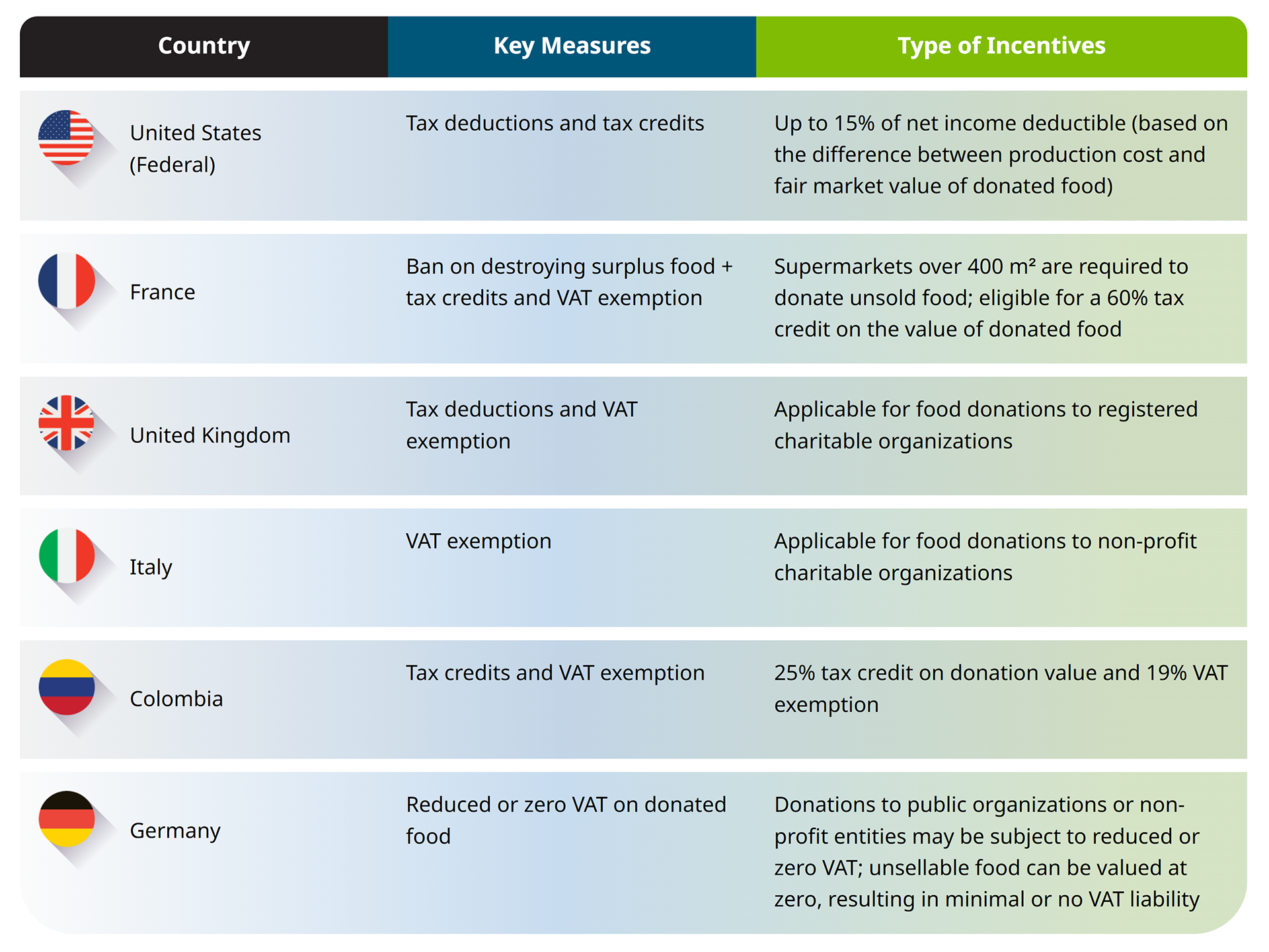
Examples of Food Donation Incentive Measures in Other Countries

Country Key Measures Type of Incentives
United States
(Federal)
Tax deductions and tax credits Up to 15% of net income deductible (based on the difference between production cost and fair market value of donated food)
France Ban on destroying surplus food + tax credits and VAT exemption Supermarkets over 400 m² are required to donate unsold food; eligible for a 60% tax credit on the value of donated food
United Kingdom Tax deductions and VAT exemption Applicable for food donations to registered charitable organizations
Italy VAT exemption Applicable for food donations to non-profit charitable organizations
Colombia Tax credits and VAT exemption 25% tax credit on donation value and 19% VAT exemption
Germany Reduced or zero VAT on donated food Donations to public organizations or non-profit entities may be subject to reduced or zero VAT; unsellable food can be valued at zero, resulting in minimal or no VAT liability

Source: NSTDA Research Team, 2025