

Fabrication Lab: A Project to develop innovation skills for Thai youth
The National Science and Technology Development Agency (NSTDA) is supported by the Thai Government to set up Fabrication Labs with an aim to develop innovative skills for Thai youth. Participation in this program was extended to secondary schools and technical colleges that have previously joined/organized activities for youth development or have been awarded in relevant competitions at regional, national or international levels. A total of 238 applicants were enrolled and 150 schools/colleges were selected to participate in this program to establish FabLabs at their schools/colleges. Ten partner universities in Thailand provided advice and mentorship to participating schools/colleges as well as recruited the engineers for each FabLab. Some relevant activities for developing skills and enhancing the capabilities of both teachers and students are organized with assistance from partner universities. This approach will maximize the use of the FabLabs to their full potential.
Project Overview
The Thai cabinet approved a considering amount of budget, on February 20, 2018, to support a large-scale project which has large impact on the general society. This project is known as “Big Rock Project” The Big Rock Project supports the set-up of FabLab, an educational and maker space, in schools across the country. Important motives for setting up the FabLab are to; inspire innovations, educate both educators and students on engineering skills, enable design and fabrication through knowledge and technical tools provided, and thereby create future opportunities for budding engineers and innovators in the next Thai generation.
FabLab project provides essential equipment and tools for engineering skills development, including laser cutting machines, 3D printers, hand tools, digital tools and scientific instruments. One hundred and fifty schools/colleges, located in 68 provinces, were selected to participate in this project, they are organized into 3 groups as follows:
1) Public schools that provide secondary level education and have continuing programs/activities to promote student participation in science, technology and innovation. The average ONET grade in mathematics and science (taken in 2016) for Matthayom 3 students in these schools is higher than the national average. And/or these schools have, in the past 3 years, participated in science/technology/innovation projects or invention by the students were awarded at the regional, national or international contests. This group of schools (total of 77) falls into “School showing interest” category.
2) Schools with all the above-mentioned qualifications and have taken part in the project for establishing science classrooms in schools (with supervision from universities, supported by the Ministry of Science and Technology), Princess Chulabhorn Science High Schools, and network schools under mentoring universities. These schools show high potential and have support from the schools’ administrators and teachers for students to participate and benefit from the Fabrication Labs. This group of schools (total of 23) falls into “School with readiness” category.
3) “Technical/vocational college based on science” category (total of 50) are technical and vocational colleges that offer technology-based courses. These colleges are under the Office of the Vocational Education Commission (VEC), Ministry of Education.
Seventy-seven schools in Category 1 are provided with small set of equipment (excluding laser cutting machine). Schools/Colleges in Category 2 and 3, with a total of 73 schools, received a larger set of equipment, including laser cutting machines.
A list of basic and necessary tools/equipment for establishing FabLabs was recommended by the Office of National Higher Education Science Research and Innovation Policy Council (formerly, the National Science Technology and Innovation Policy Office). Equipment includes the laser cutting machine, 3-D printer, digital scale, voltage stabilizer. Some measuring tools are digital camera, digital anemometer, noise meter, digital multi-meter, handheld infrared meter, handheld computer-mounted oscilloscope, non-contact thermometer, light intensity meter, DC power supply and digital display microscope. Technical tools include soldering tools and consumables. Some of the learning tools provided are scientific sensor sets, embedded system training kits, basic electrical circuit kits, DOF robot arm training kits. Safety equipment such as fire extinguisher, CCTV and first aid bag are also provided. Embedded boards “KidBright” developed by National Electronics and Computer Technology Center (NECTEC), NSTDA researchers are also provided in the FabLabs.
Through the selection process for participating schools nationwide, schools/colleges are grouped into different categories as follows.
Figure 1 Proportion of provinces with FabLab (set-up in local schools/colleges through the project) by regions in Thailand

It is apparent, from Figure 1, that FabLabs set-up by the project have made the opportunities widely accessible to youth communities in all regions of Thailand. There are FabLabs in every province situated in the eastern and northern regions of the country (7 and 9 provinces, respectively). The number of FabLabs in other parts of the country are; 19 provinces (out of 22 provinces) in the central region, 4 provinces (out of 5) in the west, 16 provinces (out of 20) in the north-east, and 13 provinces (out of 14) in the southern region of Thailand.
Figure 2 Percentage of FabLabs in each region (total of 150 FabLabs)
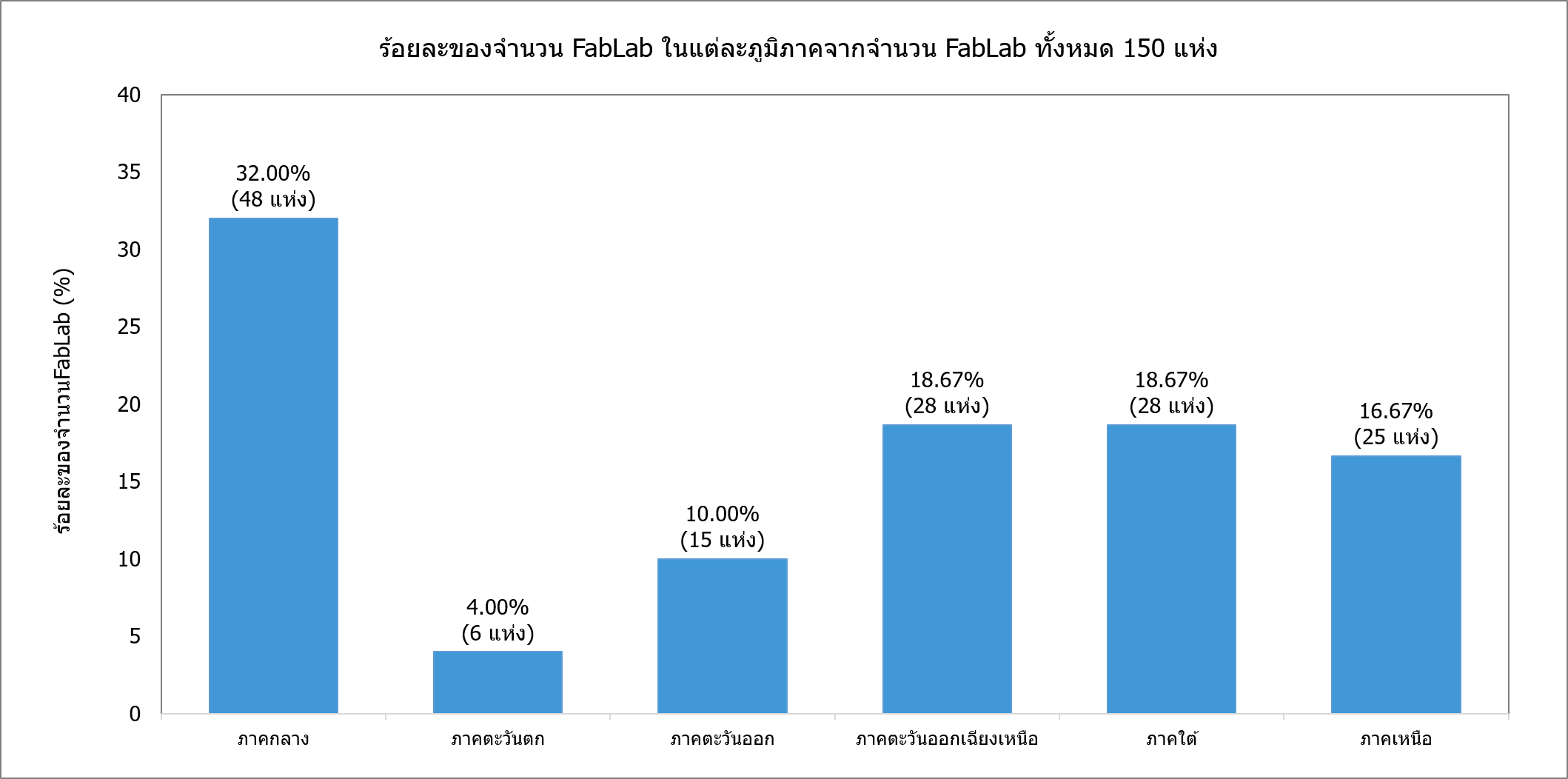
Figure 2 shows the distribution of 150 FabLabs in each region, distributed in the central region 48 places (32 percent), distributed in the western region 6 (4 percent) distributed in the region. East 15 locations (10 percent) spread in the northeast region 28 places (18.67 percent) spread in the southern region 28 places (18.67) and spread to the north 25 locations (16.67 percent). Mentors to the participating schools are provided by 10 universities, in collaboration with NSTDA, as in the following list.
1) Rajamangala University of Technology Bangkok, mentoring 15 schools/colleges
2) Rajamangala University of Technology Lanna, mentoring 14 schools/colleges
3) Rajamangala University of Technology Thanyaburi, mentoring 15 schools/colleges
4) King Mongkut’s University of Technology Thonburi, mentoring 16 schools/colleges
5) King Mongkut’s University of Technology Ladkrabang, mentoring 15 schools/colleges
6) King Mongkut’s University of Technology North Bangkok, mentoring 15 schools/colleges
7) Burapha University, mentoring 15 schools/colleges
8) Chiang Mai University, mentoring 15 schools/colleges
9) Thammasat University, mentoring 15 schools/colleges
10) Prince of Songkla University, mentoring 15 schools/colleges
The roles and responsibilities of these universities are to plan activities for their assigned schools (for the period of 12 months), to recruit and train FabLabs engineers who will be stationed at each facility for the whole duration of the project, and to give advice on equipment installation and use. Other activities such as organize training for teachers/students, act as advisors for fabrication work/project, provide assistance to create “Maker Club” at local schools, and evaluate schools’ performance are also part of the partner universities’ responsibilities.
Figure 3 Orientation for engineers, school administrators and teachers organized on August 10, 2018 by Prince of Songkla University
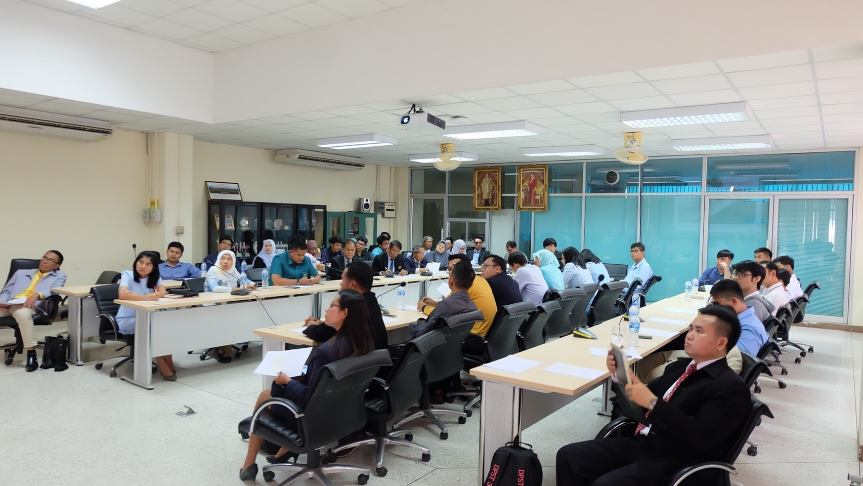
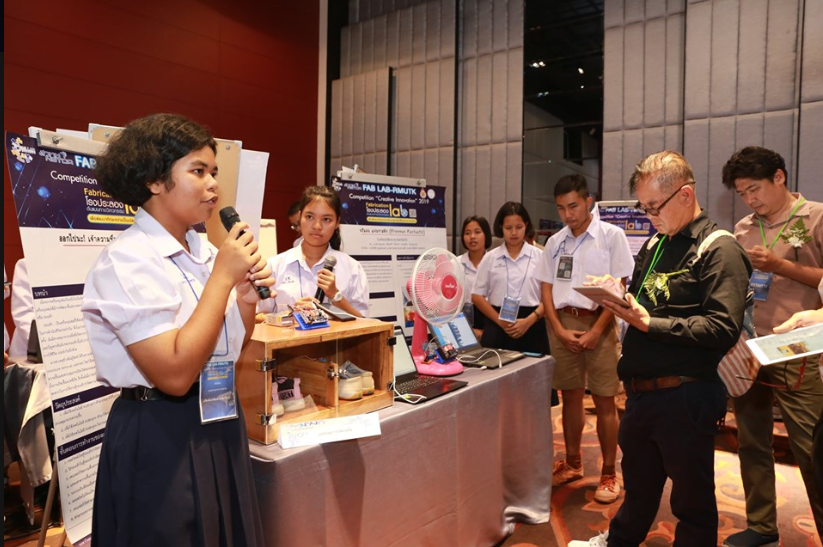
Figure 4 Creative Innovation Contest organized on September 28, 2019
Project Output
Outputs from the implementation of the Fabrication Labs projects are:
In addition, 7 innovation contests were organized by universities, with a total of 241 prototypes submitted. Details of the contests, organizers, and number of entries submitted are as follows.
Automatic Food Production Innovation Contest, King Mongkut’s University of Technology Thonburi, August 1-2, 2019, 31 entries
FABLAB Southern Competition under the theme “Digital 4.0 in Community”, Prince of Songkla University, August 20-21, 2019, 67 entries
Young Innovators Contest, Rajamangala University of Technology Thanyaburi, August 26-27, 2019, 55 entries
Invention showcase and seminar on Fabrication Lab in Schools, Chiang Mai University, August 27, 2019, 30 entries
Fabrication Lab @ Thammasat University Exhibition and Contest, Thammasat University, September 8-9 2019, 11 entries
Creative Innovation Contest, Rajamangala University of Technology Krungthep, September 28, 2019, 33 entries
Science and Technology Invention Contest, Burapha University, October 2-4, 2019, 14 entries
Project Impact
Implementation of the FabLab project has undoubtedly demonstrated the need for engineering skill development for Thai youth. To achieve this goal, it is necessary to set up facilities and creative space to encourage and support innovation. For the beginning phase, engineers at FabLabs are required to help students and teachers with tools and equipment as well as design and engineering skills. Some skills acquired by the students are ranging from designing basic work to a more complex prototype. Inventions created in the students’ work clearly reflect the acquired knowledge and innovation skills. FabLabs help to enhance and fulfill a creative learning environment more efficiently. Innovations created through the FabLab project can be further expanded and utilized in other sectors of the society. Some examples of the inventions are urine albumin protein detector for a preliminary indication of kidney disease, automatic liquid fertilizer mixer, Container (made from natural materials) forming machine, and automatic fish feeder. Most of the inventions are prototypes which are commercially viable.