
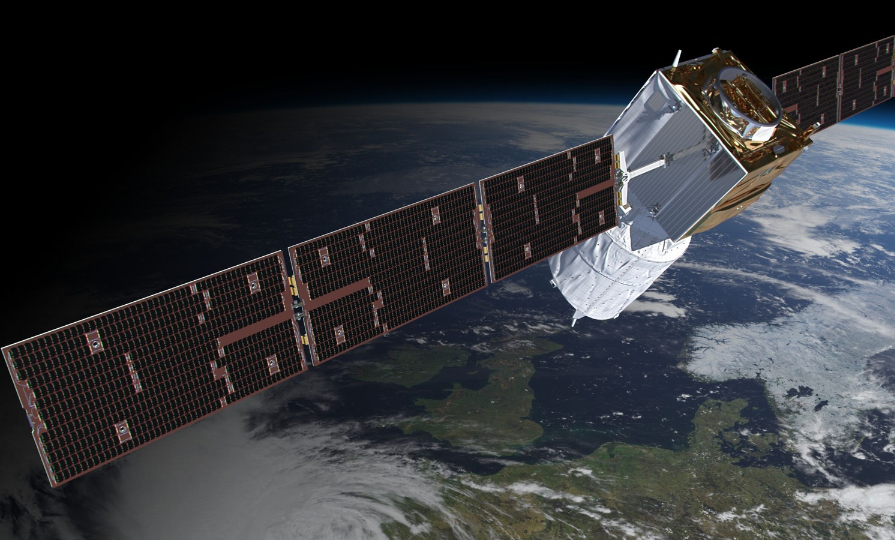
Low Earth Orbit (LEO), roughly spanning from 160km to 2,000km, is one of the most popular orbital regimes mainly due to its relatively low delta-v requirements and natural advantage for imaging and sending signals. These advantages both stem from its relative proximity to the surface of Earth.[1] However, most LEO satellites are actually positioned at around 500km altitude, which raises the question: why don’t they go lower? Indeed, this pattern of increasing orbital convenience extends to even lower altitudes, but there is a problem: the atmosphere.
Many of us like to think of the sky having air and space having none; however the atmosphere actually extends far beyond the Karman line. In fact, even satellites in regular LEO feel drag and have to regularly maneuver to correct for it. However, in Very Low Earth Orbit (VLEO), drag affects satellites on a whole new level. Below 350km or so, orbits of traditional satellites will quickly decay without a counteracting force due to the sheer number of particles hitting the satellite. And the particles aren’t your regular everyday air either. In this region of the atmosphere, the sun’s light splits O2 into a highly reactive species of oxygen known as Atomic Oxygen (AO), which makes up a large part of, and in some cases the majority of, the atmosphere in VLEO and LEO. AO, as you can imagine, is quite a strong oxidizer, and this property, in addition to chemically destroying polymers often used in satellite construction, has significant effects on satellite drag (more on this later). To conquer this orbital regime, we will either need to lessen the impact of drag, or counteract it in some way. This article will discuss how drag works in VLEO, and some strategies for reducing its effects, while the next issue(s) will focus on counteracting it.
To reduce the drag, we must first understand how it comes about in VLEO. Drag here can still be calculated from the classical formula (),[2] and therefore depends on the same variables. However, that often hides a lot of advanced physics. When we talk about drag on Earth, we mostly think of it occurring from the air changing speed (usually slowing down) or changing pressure due to being pushed around by the shape of the object and/or the bumps on the surface of it. When you change the speed / pressure of the flow, you do work on it (i.e., spend energy). We know that energy can neither be created nor destroyed, so the energy to do this work must come from somewhere. When the object moves, the energy comes from the kinetic energy of the object, in turn slowing the object down.[3]
However, the flow can only change pressure and speed because particles are able to bump into each other. A traditional (continuum) fluid functions through one particle bumping into another, which then bumps into another, and so on and so forth. This happens because particles can hardly travel without bumping into other particles. At sea level, the mean free path (how far the average particle travels before hitting another one) is about 70nm, while at an altitude of 300km, this value is about 2,600m[4]. Assuming a reasonable size of about 1 meter for a satellite, the average particle would travel over 2,500 times the length of the satellite’s body before interacting with another one[5]. A consequence of this fact is that in VLEO, you can’t really think of drag and lift the same way you do on Earth. A naive approach may consider each particle using Newtonian physics: the particle hits the satellite, and bounces off keeping all of its speed but now moving in a different direction. This results in a momentum transfer to the satellite where theta () is the angle between the particle and the surface normal (the line sticking out perpendicularly from the wall). For example, with a head-on collision, we would get 2mv, while a grazing collision’s momentum transfer would approach 0. And this model would work, if not for atomic oxygen.
Atomic Oxygen, being highly reactive, has the tendency to, well, react with things. Specifically, when an AO particle hits the metal surface of a spacecraft in the right way in the right place (known as an active site), a temporary bond is formed, and the AO particle becomes stuck to the surface. When a bond is formed, the AO particle transfers all its incoming momentum to the satellite, pushing it back slightly, and “thermalizes,” meaning that it loses a significant portion of its speed and now has the same energy as it would if it were the same temperature as the wall (remember, temperature is a distribution of different speeds, so particles also leave with a distribution of speeds). Then, after some time (on the order of a second), the particle becomes randomly unstuck from the wall, leaving in a random direction with significantly less kinetic energy than it came in with, and pushing the satellite in a random direction[6]. When a particle leaves in a random direction, it is known as a diffuse reflection, as opposed to a specular reflection where the particle bounces off the surface like light hitting a mirror. The portion of all reflections which are diffuse is known as the (Maxwell) accommodation coefficient[7]. For most materials in VLEO, this number is assumed to be around 1. Keep this in mind, as this will be important when we talk about intake designs in the next issue.
The effect of adsorption and desorption is not only limited to creating diffuse reflections either. A simulation[8] finds that a sphere experiences 12.7% of its drag from adsorption and desorption at 200km altitude, rising to around 80% at 500km depending on solar conditions. Those with a keen eye may have noticed that, compared to a particle hitting face on and imparting 2mv of momentum, under adsorption and desorption the particle only pushes the satellite back by mv + a bit from the desorption. A consequence of this difference is that adsorption is less draggy, and therefore we may actually want to encourage AO bonding with the surface and find a way to increase its accommodation coefficient. And this line of thinking is right. Simulations show that a frontal surface with all adsorption actually reduces drag by just under 40% compared to one where 70% of the reflections were specular.[9] However, those of you with an even keener eye might notice that this analysis only considers the front of the satellite.
Adsorption can also happen when the AO strikes the material at a grazing angle, and not just when it hits head on. However, the inverse relationship between adsorption and drag is not true in this case. We still get ~mv of momentum transfer in the adsorption case, but we are comparing this to a baseline of the particle hitting at a grazing angle and barely losing any momentum. With adsorption, the momentum still goes from to mv, but with a high , adsorption actually increases the momentum transfer. The same study smooths out the sides parallel to the flow to reduce the rate of AO adsorption and desorption.[10] They find that this smoothing actually significantly reduces the drag from these sides, although materials which can maintain an accommodation coefficient of 0.3 long-term currently are not known (more on this later). That’s all well and good for a single particle hitting the wall, but what about the enormous number of particles hitting the satellite every second in orbit?
When a satellite is flying in VLEO, there’s so much AO, and therefore so much adsorption happening, that a layer of adsorbed atomic oxygen forms on the satellite’s surface. How much of the satellite’s surface is covered by AO is fittingly called the AO surface coverage. Simulations show this number ranges between 60 and 75 percent when the particles are hitting head on at 200km depending on the solar conditions, dropping to a total surface coverage of about 40%[11] based on a weighted average. The reason that this does not quickly climb to 100% is that particles are also constantly desorbing, leading to a tug-of-war between incoming AO trying to stick to the surface, and already present AO trying to get out, much like a dynamic equilibrium in regular chemistry.
When an incoming AO particle wants to bond somewhere which is already full, it can’t be adsorbed, but it usually still bounces off a couple times before thermalizing and reflecting diffusely, just as if it had been adsorbed.[12] The difference is that materials designed specifically to have a low accommodation coefficient quickly fill up with adsorbed AO and have their accommodation coefficients rise to nearly one, killing their drag savings. This increase in the accommodation coefficient from AO coverage also has the downside of messing up certain intake designs which rely on specular particle reflection. When the effectiveness of the intake is reduced, so is the effectiveness of the propulsion system, leading to less drag compensation and, with enough time, the satellite burning up in the atmosphere. Now that we know how drag in VLEO works, we can move on to drag compensation, intake design, and Air-Breathing Electric Propulsion (ABEP) in the next issue(s).
Papers referenced in the article:
- Jiang, Y., Zhang, J., Tian, P., Liang, T., Li, Z., & Wen, D. (2023). Aerodynamic drag analysis and reduction strategy for satellites in Very Low Earth Orbit. Aerospace Science and Technology, 132, 108077. https://doi.org/10.1016/j.ast.2022.108077 (unfortunately not accessible without access to Elsevier)
- Huh, S., Moon, G., & Jun, E. (2025). Drag analysis incorporating atomic oxygen adsorption in Very-Low-Earth-Orbit. Aerospace Science and Technology, 158, 109900. https://doi.org/10.1016/j.ast.2024.109900
- Xu, C., Caracciolo, A., Jorge, P. D. C., Gouzman, I., Pilinski, M. D., & Minton, T. K. (2026). Inelastic scattering dynamics of hyperthermal O atoms on engineering surfaces relevant to satellites in low Earth orbit. CEAS Space Journal, 18(3), 541–558. https://doi.org/10.1007/s12567-025-00628-5
Further reading
- Crisp, N. H., Roberts, P. C. E., Livadiotti, S., Oiko, V. T. A., Edmondson, S., Haigh, S. J., Huyton, C., Sinpetru, L. A., Smith, K. L., Worrall, S. D., Becedas, J., Domínguez, R. M., González, D., Hanessian, V., Mølgaard, A., Nielsen, J., Bisgaard, M., Chan, Y.-A., Fasoulas, S., … Schwalber, A. (2020). The benefits of very low Earth orbit for Earth observation missions. Progress in Aerospace Sciences, 117, 100619. https://doi.org/10.1016/j.paerosci.2020.100619
- Preprint accessible at arxiv.org/abs/2007.07699
- Welle, R. P., Venturini, C. C., Hinkley, D. A., and Gangestad, J. W., “The DiskSat: A Two-Dimensional Containerized Satellite,” Proceedings of the 35th Annual Small Satellite Conference, SSC21-XIII-12, Utah State Univ., Logan, UT, 2021. https://digitalcommons.usu.edu/smallsat/2021/all2021/227/
[1] Zooming doesn’t work because the smallest thing you can see is affected by two separate things: the size of the pixel on the ground, and the diffraction limit. The former is affected by the focal length, and the latter by the aperture diameter. Ideally, satellites would have their optics set up such that these two values are pretty similar, and so any improvement in one without an improvement in the other is not very useful. This means that if we wanted to zoom in without moving our satellite, we would have to also increase the aperture size to reduce the diffraction limit, which is a significant size and weight investment, leading to substantially more rocket fuel as described in previous articles.
[2] That is ½ * (density * Coefficient of drag * velocity^2 * Area)
[3] This is just one of many different ways to think of drag on Earth.
[4] This value is from the U.S. standard atmosphere (1976)
[5] The ratio is known as the Knudsen number. Environments with a Knudsen number exceeding 10 are generally considered to be Free Molecular Flow (FMF), those between 0.1 and 10 are considered transitional, and those under 0.1 are considered continuum.
[6] It is not actually completely random, but instead follows a cosine distribution.
[7] Not to be confused with the energy accommodation coefficient which measures how much the particles actually thermalize (it is the ratio between how much energy the particles actually lose with a bounce and how much they would lose if they left with the same energy as the wall’s temperature). Most assume these values are pretty similar, and that all particles that reflect diffusely are thermalized, but some recent work challenges this. See footnote 12 for more details.
[8] This is Huh et al.
[9] This is Jiang et al.
[10] The study (Jiang et al.) actually doesn’t model the chemistry, and instead changes the accommodation coefficient of the sides to 0.3 (same as the smoothed front side). In the study all diffuse reflections are assumed to thermalize particles, making it a proxy for adsorption.
[11] The exact figure for total surface coverage is 0.413 = 41.3%. I inferred the 60 and 75 percent from their diagrams, which are run at slightly different altitudes (198km and 192km for solar minimum and maximum respectively). This value is from Huh et al.
[12] Orbital data suggest that the particles indeed leave thermalized when hitting a surface with high AO coverage; however some lab experiments suggest that a fraction of particles may diffusely leave with a speed significantly higher than the wall temperature. This is the disconnect between the accommodation and energy accommodation coefficients mentioned earlier in footnote 7. See Xu et al.
About Author