The National Science and Technology Development Agency (NSTDA), established under the Science and Technology Development Act B.E. 2534 (1991), carries a primary mission to strengthen the national workforce in science and technology. To support this mission, TAIST–Science Tokyo Program (formerly TAIST–Science Tokyo) was launched in 2008 through a strategic collaboration among NSTDA, the Institute of Science Tokyo (Science Tokyo) (formerly Tokyo Institute of Technology), and 6 leading Thai universities: King Mongkut’s Institute of Technology Ladkrabang (KMITL), King Mongkut’s University of Technology Thonburi (KMUTT), Sirindhorn International Institute of Technology (SIIT) Thammasat University, Kasetsart University (KU),Mahidol University (MU) and Chulalongkorn University (CU). This collaborative network aims to advance high-quality international graduate education, research, and development, with the goal of cultivating highly capable human resources to meet the growing demands of Thailand’s science and technology sectors.
In 2021, the National Research Council of Thailand (NRCT) recognized the program’s significance in human resource development and began providing continuous support to enhance its long-term impact on national capacity building.
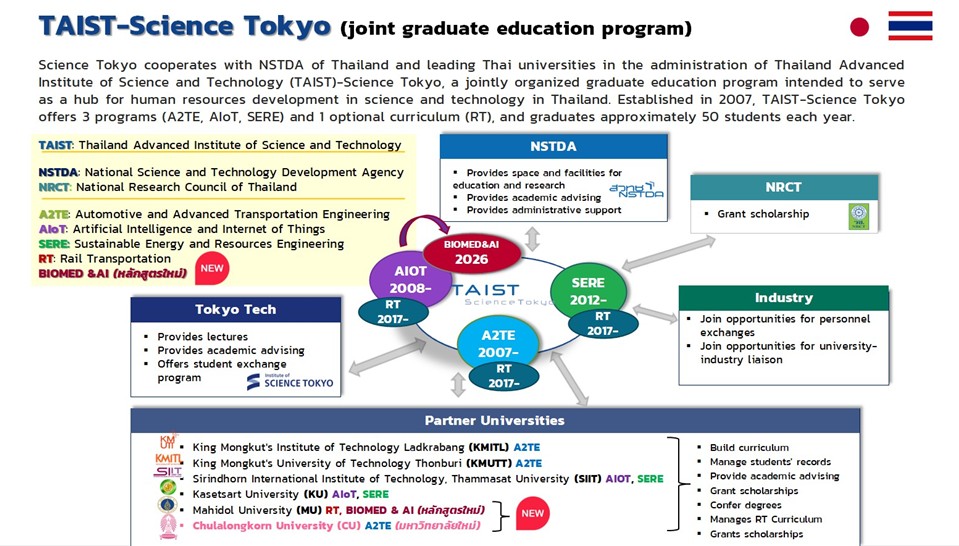
The TAIST–Science Tokyo Program currently offers three master’s degree programs and one certificate program, all designed to address critical and emerging needs in the industrial sector:
· Automotive and Advanced Transportation Engineering (A2TE): Initially hosted by King Mongkut’s Institute of Technology Ladkrabang (KMITL), King Mongkut’s University of Technology Thonburi (KMUTT), with Chulalongkorn University (CU) joining as a primary host institution in 2026.
· Biomedical Engineering and Artificial Intelligence (BIOMED & AI): Hosted by Mahidol University (MU), Sirindhorn International Institute of Technology (SIIT) Thammasat University, Kasetsart University (KU), and Chulalongkorn University (CU).
· Sustainable Energy and Resources Engineering (SERE): Hosted by Sirindhorn International Institute of Technology (SIIT) Thammasat University, and Kasetsart University (KU).
· Rail Transportation (RT) Certificate Program: Hosted by Mahidol University.
All curricula are jointly developed by Thai and Japanese faculty members together with NSTDA researchers. The programs emphasize advanced engineering competencies, analytical and synthesis skills, and essential 21st-century skills, ensuring graduates are prepared to contribute at both national and international levels.
Beyond academic training, the program fosters a robust network of collaboration among research institutes and universities in Thailand and abroad. This enhances international academic excellence and integrates the strengths of partner institutions in cutting-edge engineering fields. Students also benefit from hands-on research experience within NSTDA laboratories, industry visits, and additional skill-enhancing activities.
Moreover, the program annually offers the TAIST–Science Tokyo Exchange Program, providing approximately 15 students with opportunities for short-term academic and research exchange at the Institute of Science Tokyo. This experience broadens global exposure, enriches cultural understanding, and strengthens research capabilities.
With strong academic foundations, practical training, and international experience, TAIST–Science Tokyo graduates are well-equipped with knowledge, skills, and professional readiness to become key contributors to Thailand’s scientific and technological advancement.